Up to Ten develops Up to Connect in-house (lesson tracking + parent dashboard) and Up to Admission (university test simulations): adaptive IRT for GMAT, multistage for Digital SAT, faithful simulations for TOLC, Bocconi and others. All designed by our team, not third parties. From €36/hour.
Two platforms, one vision
Tools built by our team for our students. No generic software, no third-party plugins.
The platform that tracks every progress
Up to Connect is Up to Ten's proprietary platform, built in-house for STEM tutoring in Milan. Every lesson is tracked automatically: topics covered, assignments set, grades and progress — all visible in real time to students and parents. Included in every tutoring package from €36/hour.
Up to Connect is our proprietary app, the heart of the Up to Ten method. Every lesson, assignment, grade, and progress is tracked automatically.
- Complete tracking of every lesson
- Assignments monitored in real time
- Grade trends and improvement tracking
- Study materials shared automatically — when the tutor covers a topic, the student receives formularies and handouts produced by Up to Ten
- Direct tutor-student and parent communication
- Dedicated parent dashboard
- Real-time notifications and updates
- Lesson calendar and bookings
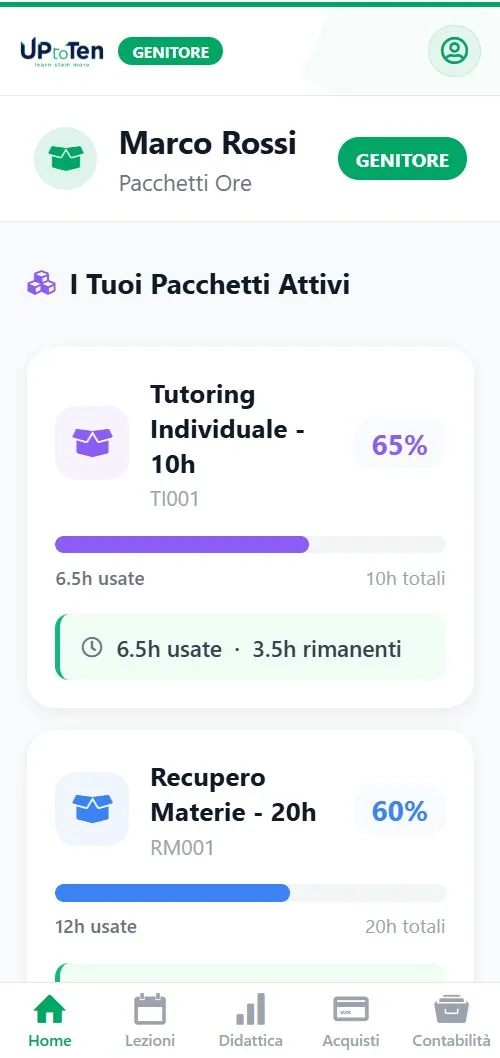
- Payment and package management
A maths lesson tracked in Up to Connect: topics covered, materials shared automatically, homework for the next lesson. Students and parents see the same screen.
Every improvement, measured
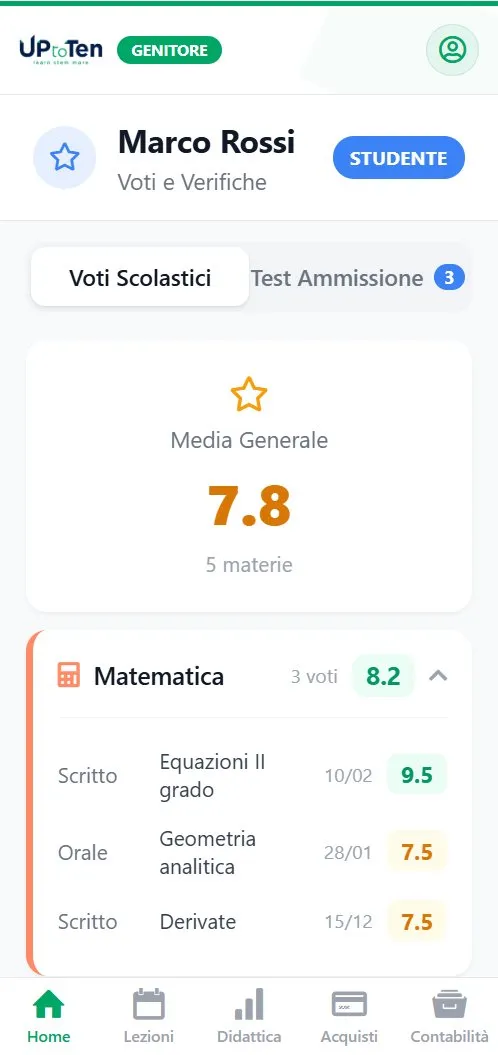
It's not enough to say "things are getting better." Up to Connect shows real grade trends over time — subject by subject, month by month. You and your parents see exactly where you are and how much you're improving.
A maths student's grade trend over 4 months. Every grade is recorded automatically after each test.
A structured path until exam day
Up to Ten's test platform is a structured preparation programme organised by topic: 2 training sessions and an assessment per module. Full exam simulations from mid-path — the goal is 10–15 completed simulations with stable results. For the GMAT, IRT technology with question-by-question adaptive difficulty.
Preparing for an admission test doesn't mean doing random quizzes. Our platform builds a progressive path: first you master each topic, then you face full simulations under real exam conditions.
Topic training
Each thematic module (algebra, functions, geometry, logic...) has 2 training sessions covering the theory and core exercises.
Single-topic assessment
After training, an assessment checks whether the topic is understood. If not, the tutor steps in before moving on. No gaps are left uncovered.
Full exam simulations
From halfway through the programme, simulations that replicate the structure, timing, and conditions of the real test. Goal: 10–15 simulations before the exam to minimise result variability.
Adaptive difficulty, question by question
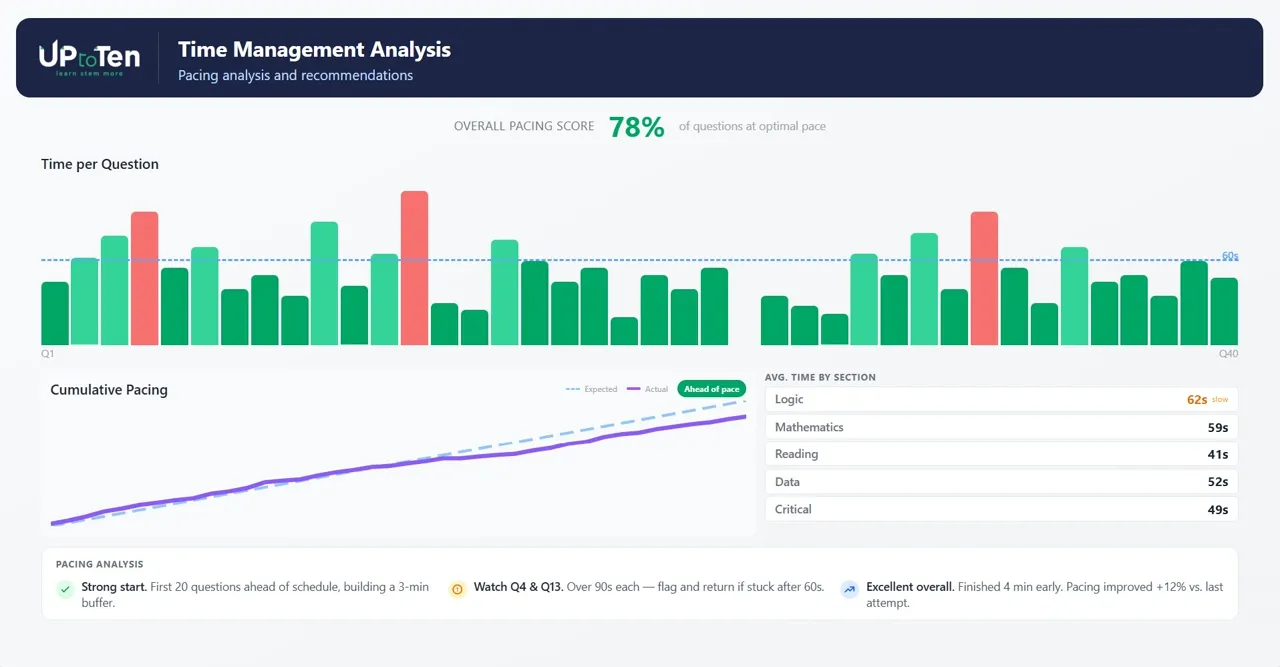
For the GMAT, Up to Admission simulations use the same IRT (Item Response Theory) logic as the official exam. Difficulty recalibrates after every answer to the student's real level.
> answerThe student answers
Every answer brings information about the student's real level.
> recalculate θThe platform recalculates θ
The algorithm estimates the updated level (θ) using the IRT model.
> next questionPicks the next one
Selects the question with difficulty calibrated to the current level.
Three adaptivity models, three faithful simulations
Every exam has its own logic. We don't simulate everything the same way.
Inside a Module
moving on
The Algebra module expanded: 2 completed training sessions and an assessment with result. The tutor sees exactly where to intervene.
Every topic, verified before moving on
Each module is opened, worked through, and verified. If the assessment confirms understanding, you advance. If it reveals gaps, the tutor intervenes with targeted lessons before moving forward. No topic is taken for granted.
- 2 training sessions for every topic
- Single-topic assessment that determines whether the topic is mastered
- The tutor intervenes where the assessment reveals gaps — no time wasted on topics already mastered
- Multiple attempts to consolidate preparation
- Visible results for every completed session
“We built our own tools because no one outside could do what we needed: a platform that puts the tutor at the centre, tracks every step of progress with real data, and gives parents a clear view without turning them into engineers. Technology serving teaching, not the other way around.”

Filippo Fiz
Co-Founder & Tech Lead
Why we build everything in-house
Generic platforms don't know your students. They don't know that Marco needs more integral exercises, or that Giulia gets anxious with timed problems.
Our tools are designed to integrate seamlessly with tutors' work. Every feature comes from a real need, not a spec sheet.
This is the advantage of having technology and education under one roof: every update improves both the tool and the Up to Ten Method.
We are not just another platform
Our technology has clear boundaries. Knowing what we don't do matters as much as knowing what we do.
We are not a generic platform
No pre-recorded lessons, no chatbots. The platform supports a real tutor — it doesn't replace them.
We are not a marketplace
No access to random freelancers. Our tutors are selected, trained and coordinated by our team.
We don't sell your data
EU servers, GDPR-compliant. Never shared with third parties, never used to train external models.
We don't replace the tutor
AI assists the tutor (material preparation, error analysis). It doesn't grade automatically, it doesn't assess the student.
AI used responsibly, data kept safe
We explain where we use AI, where we don't, and how we handle your child's data.
Where we use AI
Assisting the tutor in preparing personalised study material and in analysing recurring error patterns.
Where we DON'T
Never to grade automatically, never to replace a tutor's human judgement, never to generate pre-recorded lessons.
GDPR and student data
Servers in the European Union. Encrypted data. Right to deletion on request. We never use our students' data to train external models.